

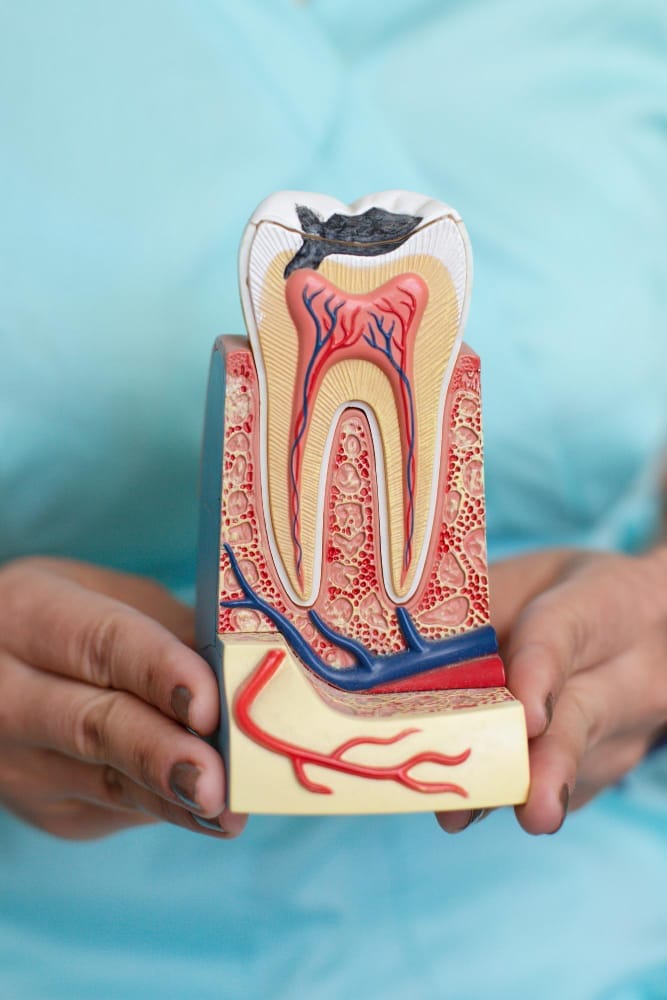

At Acorn Family Dental Care in Berkeley, Dr. Teah Nguyen uses state-of-the-art technology and techniques to perform comfortable, effective non-surgical root canal treatment. Modern root canal therapy is one of the most successful dental procedures, with success rates of 85-95%, allowing you to keep your natural tooth and avoid extraction.
This guide explains what happens during a non-surgical root canal treatment, what to expect before, during, and after the procedure, and how to care for your tooth following treatment.
Success rate of non-surgical root canal treatment
Typical treatment time (varies by case complexity)
Numbed—painless treatment with anesthesia
What Is Non-Surgical Root Canal Treatment?
Non-surgical root canal treatment (also called root canal therapy or endodontic therapy) is a procedure to save a tooth that has a severely infected or dying pulp. The pulp is the soft tissue inside your tooth containing the nerve and blood vessels.
During the procedure:
- 1. The infected pulp is completely removed from inside the tooth
- 2. The root canals are cleaned and shaped using specialized instruments
- 3. The canals are filled with a biocompatible material (gutta-percha)
- 4. The tooth is sealed to prevent future infection
The Goal
Root canal treatment eliminates the infection and allows you to keep your natural tooth. This is almost always preferable to extraction, as natural teeth function better and longer than replacements.
After root canal treatment, the tooth will need a permanent restoration (typically a crown or large filling) to protect it and restore full function.
Why Root Canals Succeed
- Eliminates the infection source completely
- Removes dead/dying tissue that causes pain
- Preserves natural tooth function
- Prevents bone loss and systemic infection
The Root Canal Treatment Process: Step by Step
Initial Examination & X-rays
Dr. Nguyen examines the tooth and takes digital X-rays to determine the severity of infection and the shape of the root canals. 3D imaging (CBCT) may be used for complex cases. The tooth is assessed for structural integrity and crack detection.
Timeline: Included in your initial appointment
Local Anesthesia Administration
The area around the tooth is numbed with local anesthetic, ensuring complete comfort throughout the procedure. A topical numbing gel is applied first, so you won't feel the anesthetic injection. You will remain completely numb for the entire treatment.
What you'll feel: Pressure and vibration only—no pain. Tell Dr. Nguyen immediately if you feel any discomfort.
Isolation with Rubber Dam
A rubber dam (thin rubber sheet) is placed over the tooth, isolating it from saliva and preventing contamination. This keeps the area dry and protected, and prevents you from accidentally swallowing water or debris during treatment.
Note: The rubber dam may feel unusual, but it's essential for treatment success. You'll be able to breathe normally around it.
Access Opening & Pulp Removal
Dr. Nguyen creates a small opening in the crown of the tooth to access the pulp chamber. Using specialized instruments, the infected/dead pulp tissue is carefully removed. This eliminates the source of infection and pain.
What you'll experience: Vibration and pressure, but no pain. You'll hear the handpiece (dental drill) but feel only gentle pressure. Suction continuously removes water and debris.
Cleaning & Shaping Root Canals
Using progressively larger specialized files, Dr. Nguyen cleans and shapes the inside of the root canals. This removes all infected tissue and bacteria from the walls of the canals, making them ready for filling. The canals are flushed with sterile solutions throughout this process.
Dr. Nguyen uses electronic apex locators and working-length X-rays to ensure each canal is cleaned to the correct depth—no longer, no shorter.
Duration: This is the longest part of the procedure, typically taking 20-45 minutes depending on the number and complexity of canals.
Root Canal Obturation (Filling)
Once the canals are cleaned and shaped, they're filled with gutta-percha—a biocompatible, rubbery material that completely seals the canals. A sealer cement helps the gutta-percha bond to the walls of the root canals, preventing bacteria from entering.
Dr. Nguyen uses warm vertical condensation or lateral condensation techniques to ensure complete, three-dimensional filling of the root canals.
Confirmation: Post-filling X-rays confirm the canals are completely filled to the root apex.
Temporary Filling & Restoration Planning
The access opening is sealed with a temporary filling. Dr. Nguyen then discusses the next step: scheduling a permanent restoration (usually a crown) to protect the treated tooth and restore it to full function.
Important: A tooth after root canal treatment needs a crown or large restoration to succeed. Do not delay scheduling this appointment—an uncrowned tooth can fail within months.
Timeline: Before, During & After Treatment
Before Your Appointment
- • Eat something before your appointment—you'll be in the chair for 1-2 hours
- • Brush and floss thoroughly to remove plaque and food debris
- • Take over-the-counter pain relief (ibuprofen) if the tooth is very painful
- • Wear comfortable clothing and plan relaxation after (you may feel tired)
During Treatment (1-2 hours)
- • 0-15 min: Anesthesia & rubber dam placement
- • 15-45 min: Access opening & pulp removal
- • 45-90 min: Cleaning, shaping & irrigation of canals
- • 90-110 min: Obturation (filling) of canals
- • 110-120 min: Confirmation X-rays & temporary filling
First 24 Hours After Treatment
Expected sensations:
- • Numbness may last 2-4 hours
- • Mild to moderate soreness when anesthesia wears off
- • Sensitivity to biting pressure
- • Possible mild swelling or inflammation
What to do:
- • Avoid eating until numbness completely subsides (risk of biting cheek/tongue)
- • Chew on opposite side of mouth—don't use the treated tooth
- • Take ibuprofen (Advil) or acetaminophen (Tylenol) for discomfort
- • Apply ice pack to outside of cheek for 15 minutes at a time (helpful for swelling)
- • Avoid hot foods/drinks; stick to soft, cool foods
Days 2-7 After Treatment
- • Most patients can return to normal activities immediately
- • Sensitivity typically resolves within 3-7 days
- • Continue to avoid chewing on the treated tooth until restoration is placed
- • Schedule your crown appointment within 2 weeks of treatment
Recovery & Aftercare Instructions
Do's After Root Canal Treatment
- Schedule your crown appointment soon—don't wait
- Take prescribed or over-the-counter pain relief as needed
- Apply ice to the outside of cheek for swelling (15 min on/off)
- Eat soft, cool foods for the first few days
- Brush and floss gently around the treated tooth
Don'ts After Root Canal Treatment
- Don't chew on the treated tooth (risk of fracture or failure)
- Don't skip your crown appointment—uncrowned teeth fail
- Don't eat hard, crunchy, or sticky foods on that side
- Don't avoid salt water rinses—they promote healing (1/2 tsp salt in 8 oz warm water)
- Don't worry about feeling the temporary filling—it's meant to be temporary
Next Step: Permanent Restoration (Crown)
After root canal treatment, your tooth needs protection. It is absolutely critical that you schedule a permanent restoration (crown) within 2-4 weeks of your root canal treatment.
Why a crown is essential:
- • Protects the treated tooth from fracture
- • Restores full chewing function
- • Prevents bacteria from re-entering the tooth
- • Ensures long-term success of root canal treatment
Critical fact:
Teeth without crowns after root canal therapy fail 5-10 times more often than crowned teeth.
Don't delay getting your crown—it's the most important step to protect your investment in root canal treatment.
Frequently Asked Questions
Question & Answer
Nothing matters more than the trust and confidence of our patients. Here's what they share about their experience with Acorn Family Dental Care Dental:
Most non-surgical root canal treatments take 1-2 hours, depending on tooth location and complexity. Front teeth with single roots are faster (30-45 minutes), while molars with multiple roots may take 1.5-2 hours. Some complex cases may require a second appointment for completion. Dr. Nguyen will discuss the estimated timeline after examining your tooth.
No. The tooth is completely numbed with local anesthesia, so you should only feel pressure—not pain. If you feel pain during the procedure, tell Dr. Nguyen immediately; more anesthetic will be applied. Many patients are surprised by how comfortable modern root canal treatment is, often comparing it to getting a simple filling.
After treatment, avoid chewing on the treated tooth until it receives a permanent restoration (crown or filling). The tooth may be sensitive for a few days—take over-the-counter pain relief if needed. Avoid hot/cold foods temporarily. Most patients return to normal activities the next day. Schedule your permanent restoration appointment immediately to protect the tooth.
Yes, root canal treatment is safe during pregnancy. The second trimester (weeks 14-20) is the ideal time for dental treatment if emergency care is needed. Dr. Nguyen takes extra precautions during pregnancy, including minimized X-ray use. However, if the treatment can wait, it's typically deferred until after delivery for your comfort.
The terms are used interchangeably and mean the same thing. Root canal treatment/therapy involves removing infected pulp tissue, cleaning and shaping the root canals, and filling them with biocompatible material. Some prefer 'treatment' while others use 'therapy'—they describe the identical procedure.
Related Pages
Need Root Canal Treatment?
Dr. Teah Nguyen provides comfortable, effective root canal therapy to save your natural tooth. Don't wait—early treatment prevents complications.
Book your dental appointment in Berkeley, CA, and discover why patients trust us for lasting, confident smiles.

Call us at
+1 510-848-011498%
Our Patient Care Retention Rate.