

If you grind your teeth at night, the next question is almost always about the mouth guard — drugstore boil-and-bite or custom night guard from the dentist? The drugstore version is $30 and on the shelf today. The custom version takes two appointments and costs ten times that. The fair question to ask is whether the price difference actually buys better protection.
The honest answer: yes, it does — but only if you actually have bruxism. This guide walks through how a custom dental night guard differs from a store-bought one, what the fitting process looks like, what it costs in 2026, and when a guard alone isn't enough. I'm Dr. Teah Nguyen, and I've fitted hundreds of these for patients across Berkeley and the East Bay.

Why Teeth Grinders Need More Than a Mouthpiece
Most patients walk in already wearing a drugstore guard. They're here because something didn't work — the guard makes them gag, falls out by morning, or didn't stop the headaches. Bruxism (the clinical name for habitual grinding and clenching) generates between 250 and 600 pounds of force per square inch. That's three to five times normal chewing force, and it happens repeatedly through the night for hours.
A piece of plastic between your teeth helps only if it stays in place, distributes that force evenly, and doesn't trigger more clenching. Off-the-shelf guards can hit one of those criteria. Two is rare. All three almost never happens. If you want the full picture of what bruxism does to your teeth, we covered that in detail in a separate post — but the short version is fractures, flattened cusps, gum recession, and over time, jaw joint damage.
How Boil-and-Bite Night Guards Fail Bruxism Patients

For mild grinders or short-term protection, a drugstore guard isn't useless. We covered the trade-offs between stock guards and boil-and-bite styles in our guide to store-bought mouth guard options. But for moderate to severe bruxism — the kind that wakes a partner, leaves jaw soreness in the morning, or shows visible enamel wear — they fall short for two reasons.
The Fit Problem: Why It Matters for Jaw Health
A boil-and-bite guard softens in hot water and molds to your top arch when you bite into it. The fit is approximate. It captures the visible portion of your teeth but doesn't account for how your upper and lower jaw actually meet. Most patients end up with a guard that's too thick in some spots, too thin in others, and not balanced across the bite.
That imbalance matters. When the guard isn't even, your jaw muscles can't relax — they keep firing because the bite feels "off." We see this clinically as muscle hypertrophy on the sides of the face, sometimes worse after a few months of OTC guard use than before.
TMJ Risk from Ill-Fitting Guards
The temporomandibular joint (TMJ) is the hinge in front of your ear that opens and closes your jaw. When a guard pushes the lower jaw into an unnatural position — slightly forward, retruded, or off to one side — the joint compensates. Over weeks and months, that compensation can cause clicking, popping, limited opening, and chronic pain. We've treated patients whose TMJ symptoms started after switching to a poorly fitting drugstore guard, not before.
What Makes a Custom Dental Night Guard Different
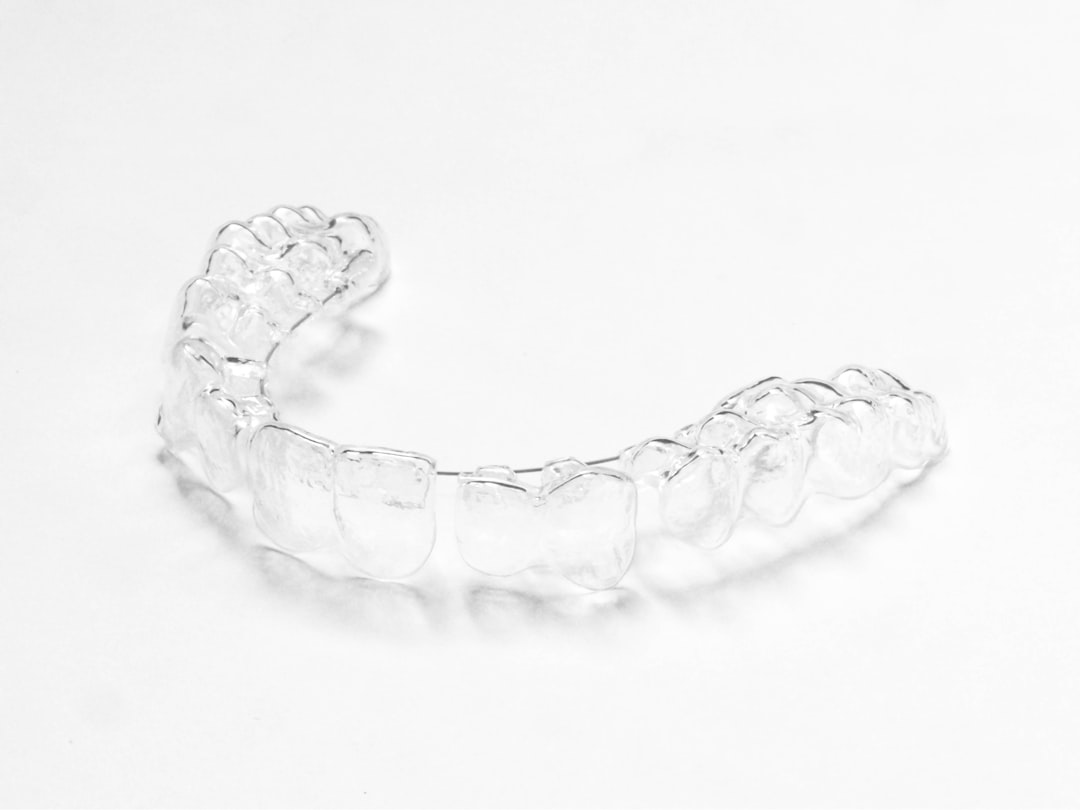
A custom night guard is fabricated from an impression of your specific arches, then adjusted in your mouth so the bite contacts evenly. Three things separate it from anything you can buy off a shelf: the precision of the fit, the material options, and the durability over time.
The Impression and Fitting Process (What Happens at the Appointment)
Visit one takes about 45 minutes. We capture impressions of your upper and lower arches — most often with a digital intraoral scanner now, which is faster and more comfortable than the older putty trays — along with a bite registration that records exactly how your jaw closes. Those scans go to a dental lab where the guard is milled or thermoformed to your specifications.
Visit two, about ten days later, is the fitting. The guard goes in, and we use articulating paper to mark every contact point between your teeth and the appliance. The high spots get adjusted with a fine bur until your bite is balanced — even pressure across every tooth, no rocking, no fulcrum points. This adjustment step is what no boil-and-bite guard can replicate.
Materials: Hard, Soft, and Dual-Laminate Options
- Hard acrylic. The standard for moderate to severe bruxism. Rigid, durable, and protects enamel by redistributing force. Best for patients with significant wear or jaw symptoms.
- Soft (thermoplastic) guards. More comfortable initially, but heavy grinders chew through them in months. Better suited to mild grinders or athletes needing impact absorption.
- Dual-laminate. Soft inside against the teeth, hard outside facing the opposing arch. A middle path — comfort plus protection — and what we recommend most often for patients who can't tolerate a fully rigid guard.
Durability Comparison: Custom vs. Store-Bought
A boil-and-bite guard typically wears through or distorts within three to six months for an active grinder. A custom hard acrylic guard lasts three to five years. So even on raw replacement cost — six $35 drugstore guards over three years versus one $500 custom guard over the same period — the custom option is competitive before you account for the protection difference.
How Much Does a Custom Night Guard Cost?

At our Berkeley office in 2026, a custom night guard runs:
- Hard acrylic: $500 to $700
- Dual-laminate: $450 to $600
- Soft thermoplastic: $400 to $500
That includes the scan or impression, lab fabrication, the fitting appointment, and any minor adjustments needed in the first 30 days.
What Dental Insurance Covers
Many PPO plans cover 50% to 80% of a night guard when bruxism is documented as a clinical finding — meaning we've noted the wear patterns, jaw symptoms, or muscle tenderness in your chart. We verify your specific benefits before quoting a final out-of-pocket cost. HSA and FSA dollars apply across the board because a night guard is treated as a medical appliance for IRS purposes. For patients without coverage, our in-house payment options spread the cost over several months at no interest.
Cost vs. the Price of Not Treating Bruxism
The economic case for a custom guard is honestly the easy part. A single porcelain crown — required when grinding fractures a molar — runs $1,500 to $2,800. A full set of crowns to rebuild a worn-down bite runs $20,000 and up. A custom night guard at $500 to $700 prevents both, and prevents the chronic jaw pain that pushes some patients toward physical therapy or oral surgery.
How to Care for a Custom Night Guard
Your guard is an investment, and a few simple habits keep it in working condition for the full lifespan:
- Rinse it in cool water after every use. Hot water warps the acrylic.
- Brush it gently with a soft toothbrush and mild dish soap (not toothpaste — abrasives scratch the surface).
- Store it dry in the case, not in a sealed bag where bacteria thrive.
- Bring it to every six-month cleaning. We check the fit and look for wear patterns that signal grinding force is increasing.
- Keep it away from pets. Dogs and the smell of saliva are not a good combination for $500 of acrylic.
When a Night Guard Alone Isn't Enough
A custom night guard protects your teeth from grinding damage, but it doesn't always resolve the jaw pain that comes with chronic clenching. About one in four bruxism patients we see has TMJ symptoms severe enough to need additional treatment beyond a guard.
Signs Your Grinding Is Causing TMJ Damage
- Clicking, popping, or grating sounds when you open or close your mouth.
- Jaw locking — the inability to fully open or close, even briefly.
- Pain in front of the ear that radiates into the temple or down the neck.
- Limited opening: less than 35-40 mm between your incisors when you open as wide as you can.
- Headaches concentrated at the temples that worsen through the day.
If any of these are present, the guard is part of the answer but not the whole answer. We address them with bite adjustment, targeted physical therapy referrals, and sometimes a different appliance design altogether.
What Comes Next: TMJ Treatment at Acorn Family Dental
For patients with active TMJ symptoms, our TMJ treatment program in Berkeley takes a conservative, non-surgical approach: diagnostic imaging, muscle assessment, custom occlusal splints designed differently than a standard night guard, and coordination with sleep medicine when grinding is tied to sleep apnea and oral appliance therapy. The American Dental Association's clinical guidance on bruxism and TMJ care aligns with this multi-modal approach — guards alone don't solve every case.
If you're grinding, sore in the morning, or unsure whether your drugstore guard is doing enough, the next step is straightforward: book a bruxism evaluation at our Berkeley office. We'll examine your wear patterns, walk through what your insurance covers, and give you a written estimate before any decisions get made.
Photos by Diana Polekhina, engin akyurt, Geniova Technologies, and MD Duran on Unsplash.